


 Español
 عربى
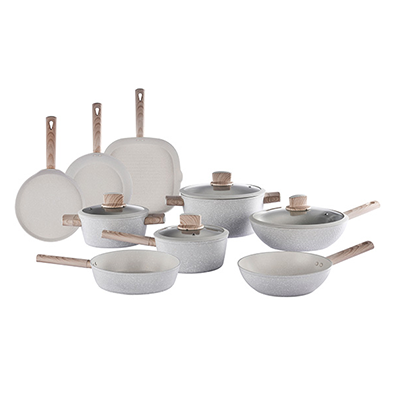
Global cookware buyers are rebuilding product lines around material performance, and the shift is changing how a cookware manufacturer is evaluated. The next stage of cookware competition will be shaped less by product variety alone and more by cookware material performance, functional differentiation, and market-specific product planning. A cookware supplier that can explain why one aluminum grade suits a European market and another suits a North American one is more useful than one that simply offers a larger catalogue. For an OEM cookware manufacturer, this means product development now starts with the material question rather than the shape question.
Material performance is now a market decision
A non-stick cookware manufacturer that sells into several regions faces different expectations for coating durability, base thickness, and weight. Aluminum cookware is common across markets, but the alloy, temper, and thickness that suit a gas hob in one country may not suit an induction hob in another. Lightweight cookware is valued in some markets for everyday handling, while durable cookware is valued in others for long service. Non-stick cookware also varies in expectation: some markets accept a coating that lasts a few years, while others expect it to survive daily use with metal utensils. An aluminum cookware manufacturer that supplies several regions should be able to explain these differences rather than offering one specification for all.
How to choose cookware materials for different markets
Material selection is where material performance in cookware sourcing becomes practical. Two points deserve attention:
- Heat source and hob type should drive the base material and thickness, since induction requires a magnetic layer while gas allows a simpler construction;
- Coating system and substrate should be matched to the cleaning habits of the market, because a coating that survives gentle hand washing may not survive abrasive cleaning.
Buyers should ask how the manufacturer tests these combinations, and whether it can provide performance data rather than assurances. A cookware factory China buyers work with across several markets should be able to explain why a product was specified differently for each one.
Multifunctional cookware raises the material question
Multifunctional cookware adds features such as removable handles, stackable shapes, or dual-use lids, and each feature places new demands on the material. A removable handle puts stress on the mounting point, and a stackable design changes how the base distributes load. Buyers should ask how the material was chosen for these stresses, and whether the manufacturer tested the assembled product rather than the body alone. How to evaluate an aluminum cookware manufacturer often comes down to whether it can explain these interactions clearly.
Private label product development starts with material
Cookware product development for private label brands usually begins with a target price and a shelf position, but the material decision determines whether the product can meet both. A brand that wants a lightweight pan at a low price may need a thinner base, which affects durability and coating life. Buyers should ask how the manufacturer balances these constraints, and whether it can propose a material plan rather than simply quoting on a drawing. A supplier that raises these trade-offs early saves the buyer from a product that meets the price but fails in use.
What buyers should verify
Rather than comparing catalogue breadth, buyers can ask how material choices are mapped to markets, how coating and substrate are matched, how multifunctional features affect material stress, and how product development balances price and performance. Suppliers who answer with test data and market-specific reasoning are easier to trust than those who answer with a product list. The cookware itself is a familiar product; the difference lies in whether material performance was planned rather than assumed.