


 Español
 عربى
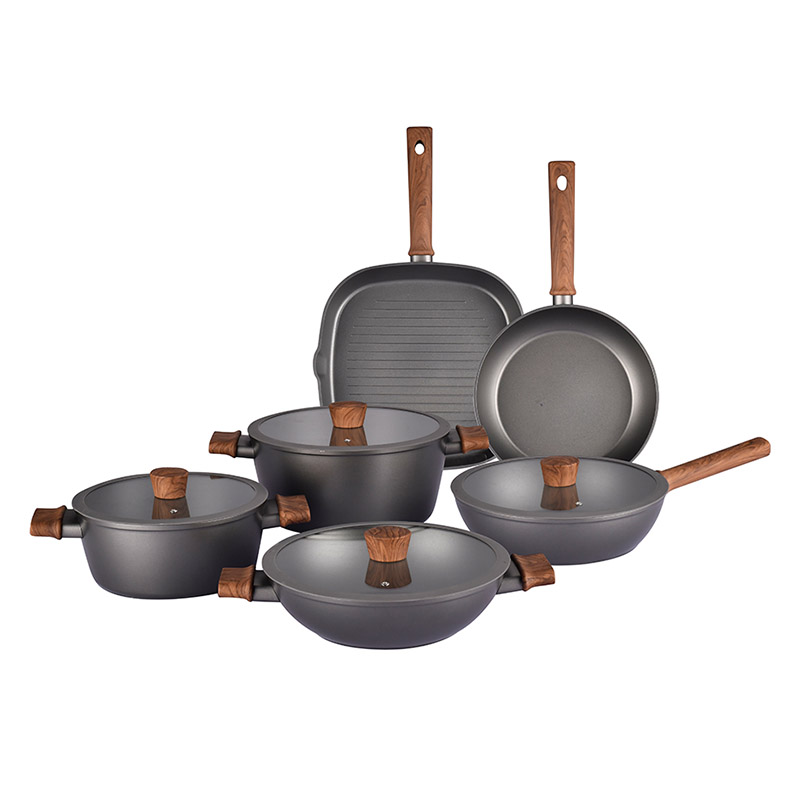
Cookware sets are evolving from simple product bundles into strategic retail products that help brands serve different price points, usage scenarios, and sales channels. For a cookware manufacturer, this shift means set design now starts with the retail shelf rather than the factory floor. A cookware supplier that can build several configurations from a shared platform is more useful than one that offers only fixed bundles. An OEM cookware manufacturer and a private label cookware partner are increasingly asked to develop a range that works across channels, and a cookware factory China buyers rely on is expected to explain how one tooling investment can support several set variants.
Sets solve a retail problem, not a kitchen problem
A set lets a retailer offer an entry price point, a mid-range option, and a premium option from the same product family. That is why cookware set product development now begins with price architecture. Buyers should ask how many set configurations a supplier can support from one tooling base, and whether the differences are limited to piece count or extend to coating, handle, and packaging. A supplier that can vary the bundle without retooling every piece is easier to work with across a season, and how to develop a cookware set becomes a question of platform planning rather than piece-by-piece design.
Non-stick sets carry the volume, but the coating decides the tier
Non-stick cookware sets are often the volume driver in a range, and the coating system decides which price tier a set can occupy. Buyers should ask how many coating layers are applied, how the coating is tested for abrasion, and whether the same body can carry different coating grades. A set that uses one coating for all tiers cannot serve the price architecture the retailer needs, and a supplier that can explain the coating ladder is more useful than one that offers a single specification.
Multifunctional sets answer space and usage questions
Multifunctional cookware set designs respond to smaller kitchens and multi-purpose cooking, and they change what a set has to include. Space-saving cookware and nested cookware set designs are part of the same trend, since a set that stacks into less cupboard space is easier to sell to urban buyers. Three points deserve attention when a set is designed around nesting:
- Whether the nested stack remains stable when a piece is removed, since a set that collapses when one pan is taken out frustrates the user;
- Whether handles and lids allow the pieces to nest without scratching, because coating damage in a nested set is a common complaint;
- Whether the nesting design still allows each piece to be used on the hob the market uses, since a space-saving shape can compromise base diameter.
How to choose cookware set sizes for a market
How to choose cookware set sizes depends on household size, cooking habits, and the retail channel. A four-piece set may suit a starter apartment, while a ten-piece set suits a family or a gift purchase. Buyers should ask how the supplier arrived at the piece count, whether the set includes pieces that are rarely used, and how the set compares with what competitors offer at the same price. A set with too many pieces raises cost without adding perceived value, and a set with too few feels incomplete.
Private label collections need a platform, not a product
How to create a private label cookware collection is really a question about platforms. A collection that shares bodies, handles, and lids across sets is easier to manage than one where every set is unique. Buyers should ask how the supplier plans the platform, whether tooling is shared, and how packaging changes between sets. Cookware set product development for retailers works best when the supplier can propose a plan rather than quote on a drawing, and when the plan accounts for the retailer's price tiers and shelf space.
What retailers should confirm before committing
Rather than comparing piece counts and prices, buyers can ask how many set variants one tooling base supports, how the coating ladder maps to price tiers, how nesting affects stability and coating wear, and how the private label collection is planned across a season. Suppliers who answer with platform thinking and test data are easier to trust than those who answer with a catalogue. The set is a familiar product; the difference lies in whether it was designed as a retail tool rather than a bundle of pans.