

 Español
 عربى
عربىDeveloping a private label cookware line is a real opportunity, but it also comes with some common pitfalls. The key is knowing how to work with a cookware manufacturer the right way. Based on what we have seen working with buyers from different markets, here is a practical step-by-step approach.
Start with a Clear Product Concept
A lot of people reach out to a cookware manufacturer with nothing more than "I want to make a frying pan." That usually leads to confusion and wasted time. Before you contact any factory, get your product concept straight.
Define your target customers. Are you selling to home users or professional kitchens? Then list the basics: pan types (frying pans, saucepans, woks, crepe pans), sizes, colors, handle materials, and coating requirements. The more details you have upfront, the faster a cookware manufacturer can give you a realistic answer. If you are not sure about some specifications, that is fine – but at least know what you want the final product to do.
Understand the Manufacturer's MOQ
Minimum order quantity is one of the first things you need to clarify. Every serious cookware manufacturer has an MOQ, and it exists for practical reasons. Factories need to purchase raw materials, set up production lines, and cover machine adjustment costs.
Do not expect a factory to accept 50 pieces for a private label order. That is not how mass production works. Instead, ask directly: what is your MOQ per SKU? Some manufacturers offer lower MOQs if you use their existing molds. Custom molds will cost more and require higher quantities. Knowing this number early helps you plan your budget. A reliable cookware manufacturer will be transparent about their MOQ policy. If you are a new brand, look for one that allows a trial order of 500 to 1,000 units per item.
Ask for Product Samples
Samples are not optional. They are your only way to verify quality before mass production. After you and your cookware manufacturer agree on the product specifications, request pre-production samples. You will most likely need to pay a sample fee and shipping cost. That is standard.
Once the samples arrive, do real testing. Cook with them. Check the nonstick performance. Examine the handle rivets and coating adhesion. Compare everything against your spec sheet. If the coating scratches too easily or a handle feels loose, go back to the cookware manufacturer with clear feedback – include photos and measurements. Repeat the sampling process until the product meets your standards. Do not approve mass production based on a single sample you have not physically tested.
Work on Branding Details
Private label is more than just putting your logo on a pan. Branding involves packaging, labels, laser engraving, and sometimes even the color of a silicone grip. A good cookware manufacturer offers OEM services to handle these, but you need to provide clear instructions.
Give your manufacturer vector files of your logo with exact Pantone colors. Specify where the logo should appear – on the bottom of the pan, the handle end, or the box. Decide whether you want it printed, embossed, or laser etched. Also discuss retail packaging early. A professional cookware manufacturer can source gift boxes or hang tags, but they cannot design them for you without artwork. This phase is where many private label projects get delayed, simply because the buyer did not prepare their branding materials in advance.
Start with a Small Production Run
Once samples are approved and branding details are confirmed, do not place a huge order immediately. Start with a small production run – sometimes called a pilot run. This is typically 20% to 30% of your planned first order quantity.
A small run lets you confirm that your cookware manufacturer delivers consistent quality across multiple batches. It also gives you real inventory to test customer response. If any hidden issue appears – such as packaging damage during shipping or minor coating variations – you can address it without losing a large investment. After the small run proves successful, scale up to full container orders with confidence.
How One Cookware Manufacturer Actually Works with Clients
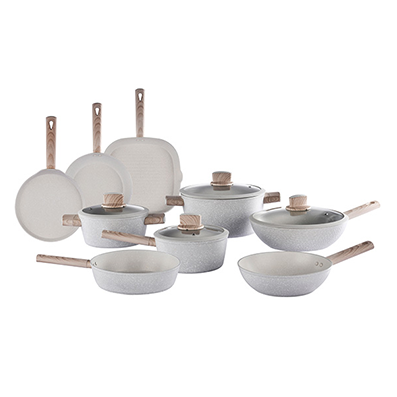
These steps work in practice. Take Zhejiang Changyuan Technology Co., Ltd., which operates under the brand TELAMON. They have been a specialized cookware manufacturer since 2009, focusing on aluminum nonstick products including saucepans, milk pots, casseroles, frying pans, woks, crepe pans, square grill pans, and steamers.
Today, Changyuan exports to markets across the world – Argentina, Chile, Brazil, Mexico, Panama, Saudi Arabia, the UAE, Indonesia, Europe, and the United States. They offer OEM services and welcome custom orders, helping clients develop products tailored to specific target markets. All cookware uses coatings that comply with LFGB, FDA, SGS, and RoHS standards, with additional certifications available upon request.
Integrating R&D, manufacturing, sales, and after-sales service, Changyuan focuses on affordable quality and long-term partnerships. If you are looking for a cookware manufacturer that follows a customer-first philosophy, visiting their factory is a practical next step. They warmly welcome global visitors.